
Blog
Rosemary Essential Oil Manufacturer in India

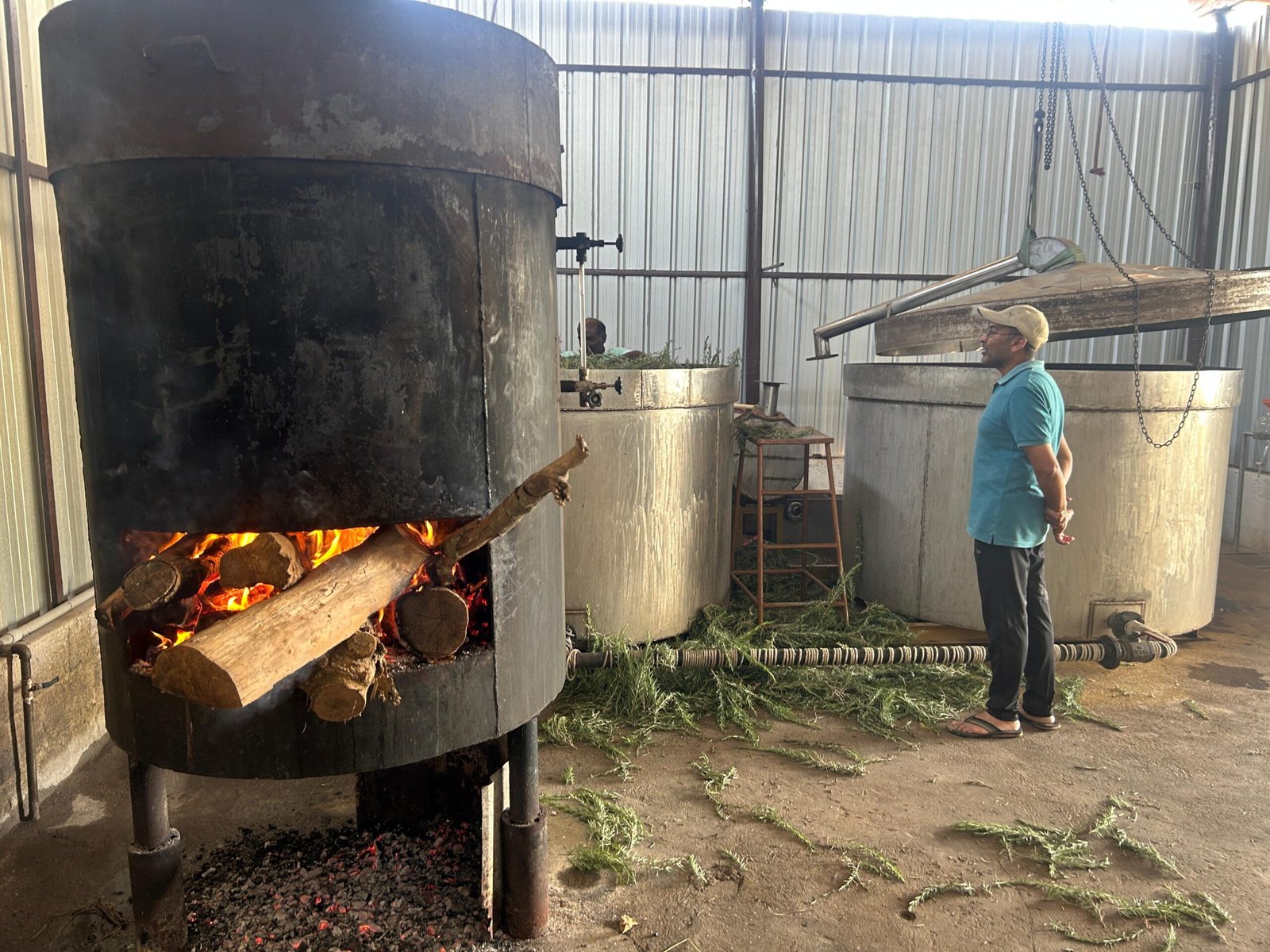
Steam-Distilled Rosemary Essential Oil for Commercial & Industrial Applications
Choosing a rosemary essential oil manufacturer is about far more than comparing prices or requesting quotations. The true quality of rosemary essential oil is determined long before the oil reaches a drum or bottle. It begins in the field, continues through harvest planning, and depends on every decision made during distillation, quality evaluation, storage, and packaging.
For manufacturers, consistency matters just as much as quality. Cosmetic brands expect every formulation to perform the same. Aromatherapy companies require a familiar aroma profile across batches. Hair care manufacturers rely on dependable raw materials to maintain product stability, while exporters and industrial buyers need confidence that supply can be maintained over the long term.
At Swastik Natural Oils, we have spent more than 25 years working with aromatic plants and essential oils. Our focus has always been on building a dependable commercial supply chain rather than simply producing essential oils. With an annual rosemary production capacity of approximately 270–400 tonnes, an extensive farmer network, and an FSSAI-licensed facility, we work with businesses across the cosmetic, wellness, food, herbal, and essential oil industries.India continues to strengthen its position as a supplier of agricultural and value-added products in international markets, supported by organisations such as the Agricultural and Processed Food Products Export Development Authority (APEDA), which promotes agricultural exports from the country.
Whether you are developing a new product, scaling an existing range, or looking for a long-term manufacturing partner, understanding how rosemary essential oil is produced—and what separates a dependable manufacturer from an ordinary supplier—can help you make better sourcing decisions.
Quick Summary
If you’re evaluating a rosemary essential oil manufacturer in India, here are the factors that deserve the most attention:
- The quality of the harvested rosemary.
- The manufacturer’s cultivation and sourcing practices.
- Steam distillation process and operational control.
- Batch-to-batch consistency.
- Availability of GC/MS reports and technical documentation.
- Commercial production capacity.
- Packaging options for domestic and export markets.
- Long-term supply capability.
Each of these factors directly influences the consistency and suitability of rosemary essential oil for commercial manufacturing.
Why Choosing the Right Manufacturer Matters
Rosemary essential oil is widely used across multiple industries, including personal care, cosmetics, aromatherapy, pharmaceuticals, herbal formulations, wellness products, and industrial fragrances. While many manufacturers may offer rosemary oil, the production process behind each batch can vary significantly.
Factors such as harvest maturity, plant health, distillation parameters, storage conditions, and quality evaluation all contribute to the final characteristics of the oil. Two batches labelled as “rosemary essential oil” may differ noticeably in aroma, appearance, and chemical composition if these stages are not carefully managed.
For businesses manufacturing finished products, such variations can affect formulation consistency, product performance, and customer expectations. Choosing a manufacturer with established production systems and a reliable supply chain therefore becomes an important commercial decision rather than simply a purchasing exercise.
Bulk Rosemary Supplier, Manufacturer & Exporter in India
Looking for a reliable rosemary supplier? Our Rosemary Leaves in India guide explains how commercial buyers evaluate quality, compare suppliers, and source rosemary in bulk.
From Farm to Distillation: Where Quality Really Begins
One of the biggest misconceptions in the essential oil industry is that quality is created inside the distillation unit. In reality, the foundation of a good essential oil is laid much earlier.
Healthy cultivation practices, appropriate irrigation, timely harvesting, careful handling of fresh plant material, and efficient movement from field to distillation all influence the quality of the finished oil. Once the aromatic compounds within rosemary begin to degrade after harvest, they cannot be restored during processing.
Much of this process begins with cultivation itself. Our detailed guide on Rosemary Cultivation in India explores the agronomic practices that influence crop quality before harvest.
Sustainable cultivation practices, efficient water management, and improved farming methods continue to play an important role in India’s medicinal and aromatic plant sector. The Ministry of Agriculture & Farmers Welfare regularly publishes initiatives and resources supporting agricultural development across the country.
This is why commercial manufacturers increasingly value supply chains that are integrated from cultivation through production, rather than relying solely on open-market procurement.
At Swastik Natural Oils, we view distillation as one stage within a much larger quality system. Every stage—from cultivation planning to harvest coordination and post-harvest handling—contributes to producing a consistent rosemary essential oil suitable for commercial applications.
Swastik Farm Snapshot
| Parameter | Details |
|---|---|
| Industry Experience | 25+ Years |
| Annual Rosemary Production Capacity | 270–400 Tonnes |
| Farmer Network | Extensive Commercial Grower Network |
| Manufacturing Facility | FSSAI Licensed |
| Industries Served | Cosmetics, Personal Care, Wellness, Food, Herbal & Industrial |
| Supply Capability | Bulk Domestic & Export-Oriented Orders |
Manufacturer vs Trader: Understanding the Difference
Many commercial buyers source rosemary essential oil through traders or intermediaries. While this may be suitable for occasional purchases, manufacturers with direct cultivation and production involvement often provide greater consistency, traceability, and long-term supply reliability.
| Buying Through a Trader | Buying Directly from a Manufacturer |
|---|---|
| Limited visibility into production | Better understanding of cultivation and manufacturing practices |
| Batch availability depends on market | Planned production and supply |
| Limited technical information | Greater access to product specifications and documentation |
| Variable sourcing | Better consistency across commercial orders |
| Less production oversight | Greater control over quality processes |
If your requirement extends beyond essential oil manufacturing to bulk raw material procurement, our Bulk Rosemary Supplier in India guide explains commercial sourcing, packaging, quality standards, and supply planning in greater detail.
The right sourcing approach depends on your purchasing requirements, but businesses with recurring production schedules often benefit from working directly with an experienced manufacturer.
Swastik Insight
Over the years, we have found that commercial buyers rarely face challenges because one batch of rosemary essential oil is exceptionally poor. More often, the difficulty lies in inconsistency between batches. Maintaining dependable quality requires disciplined cultivation, planned harvesting, organised production schedules, and consistent evaluation—not just efficient distillation.
For this reason, our emphasis has always been on strengthening the entire supply chain rather than focusing on a single stage of manufacturing.
How Rosemary Essential Oil Is Manufactured
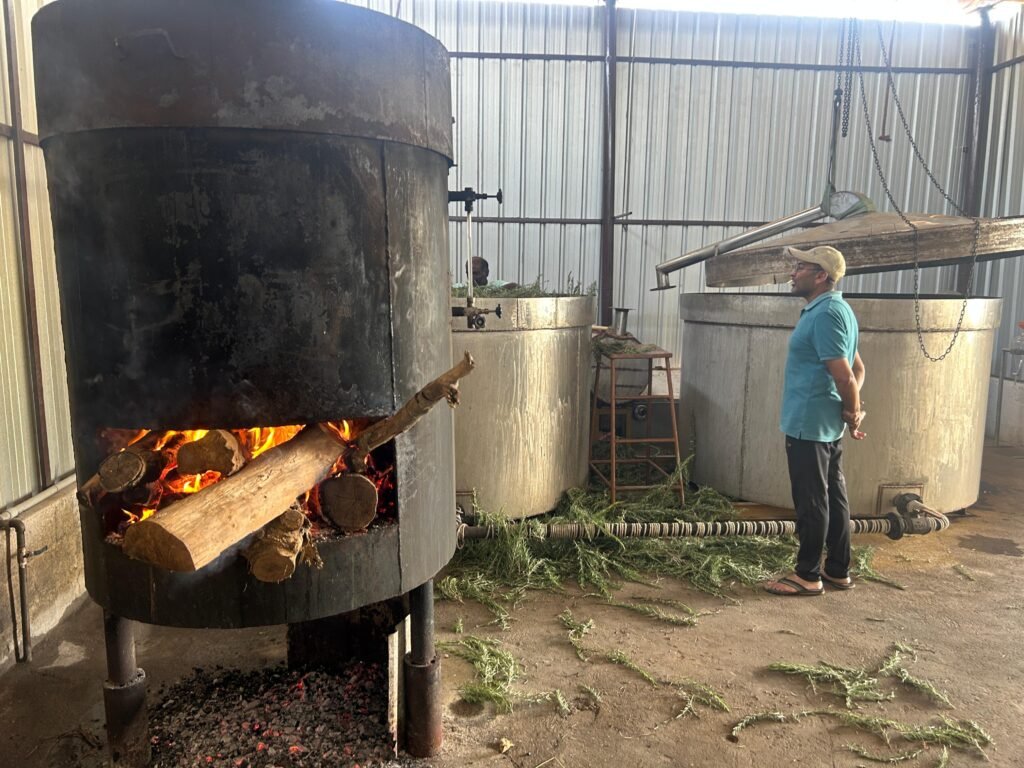
Steam distillation is the most widely accepted method for extracting rosemary essential oil. Rather than using chemical solvents, this process relies on steam to release the aromatic compounds naturally present within the leaves and flowering tops of the rosemary plant.
As steam passes through freshly harvested rosemary, it gently carries the volatile aromatic compounds into a condenser where the vapour cools back into liquid. Since essential oil and water naturally separate, the oil can then be collected without altering its characteristic aroma.
Although the principle is straightforward, producing a consistent commercial-grade rosemary essential oil requires careful control over every stage of the process. Factors such as harvest timing, freshness of the plant material, distillation duration, temperature management, and storage conditions all influence the final quality of the oil.
For commercial manufacturers, the objective is not simply to maximise oil yield but to achieve repeatable quality from one production batch to the next.
Learn more about rosemary cultivation in our Ultimate Guide to Rosemary in India.
From Harvest to Essential Oil
Every batch of rosemary essential oil follows a series of interconnected stages. A weakness at any point can affect the finished product.
| Stage | Purpose |
|---|---|
| Harvest Planning | Select rosemary at the appropriate stage of maturity. |
| Harvesting | Minimise physical damage to preserve aromatic compounds. |
| Transportation | Move fresh material efficiently for processing. |
| Steam Distillation | Extract volatile aromatic compounds. |
| Filtration | Remove natural impurities after extraction. |
| Quality Evaluation | Assess aroma, appearance and technical parameters. |
| Packaging | Protect the oil during storage and transport. |
Unlike many agricultural products, essential oils cannot be “improved” after production. Once aromatic compounds are lost through poor harvesting or delayed processing, they cannot be restored later.
What Determines the Quality of Rosemary Essential Oil?
Many buyers assume that all rosemary essential oils are essentially the same. In practice, the quality of rosemary oil depends on a combination of agricultural, manufacturing, and post-production factors.
1. Quality of the Raw Material
Healthy plants grown under suitable conditions generally provide better-quality raw material for distillation. Plant stress, disease, poor harvesting practices, or prolonged storage before processing can all influence the resulting oil.
2. Harvest Timing
Harvesting rosemary at the right stage is one of the most important decisions in essential oil production.
The maturity of the plant influences both the aroma and the overall composition of the oil. Harvesting too early or too late may alter the balance of naturally occurring aromatic compounds, which can affect product consistency for commercial manufacturers.
Harvest planning begins in the field. Our Rosemary Cultivation in India guide explores how growing practices influence essential oil quality.
3. Freshness Before Distillation
Freshly harvested rosemary retains its volatile aromatic compounds more effectively than material that has been left exposed for extended periods.
Efficient movement from field to distillation therefore plays an important role in preserving the natural characteristics of the oil.
4. Distillation Process Control
Steam pressure, distillation duration, equipment maintenance, and process consistency all contribute to the overall quality of the finished oil.
Commercial manufacturers focus on repeatability rather than maximising production from a single batch.
5. Storage After Distillation
Once produced, rosemary essential oil should be stored under suitable conditions to minimise unnecessary exposure to light, air, heat, and moisture.
Proper storage helps maintain the oil’s stability during transportation and long-term commercial use.
Understanding Rosemary Chemotypes
One of the most misunderstood aspects of rosemary essential oil is the concept of chemotypes.
A chemotype refers to the naturally dominant aromatic compounds found within a particular rosemary plant population. While all rosemary belongs to the same botanical species, environmental conditions, genetics, and growing location can influence which compounds are present in higher concentrations.
The three chemotypes most commonly encountered in commercial markets include:
| Chemotype | Common Characteristics | Typical Applications |
|---|---|---|
| Cineole (1,8-Cineole) | Fresh, clean, herbaceous aroma | Aromatherapy, personal care, wellness products |
| Camphor | Stronger, sharper aroma | Industrial formulations, massage oils, functional blends |
| Verbenone | Softer, sweeter profile | Premium cosmetic and skincare formulations |
The appropriate chemotype depends entirely on the intended application. Rather than asking which chemotype is “best,” buyers should determine which profile best suits their formulation requirements.
Why GC/MS Reports Matter
Commercial buyers frequently request a GC/MS (Gas Chromatography–Mass Spectrometry) report when evaluating rosemary essential oil.
A GC/MS report provides a detailed profile of the naturally occurring constituents present within the oil. This allows manufacturers to better understand the chemical composition of each production batch and compare it with their own formulation requirements.
While GC/MS analysis is an important quality assessment tool, it should not be viewed in isolation. The report provides information about composition, but it does not replace good cultivation practices, careful distillation, or consistent production systems.
The most dependable manufacturers combine technical testing with disciplined agricultural and manufacturing processes to deliver reliable batch-to-batch consistency.
Commercial Buyer’s Checklist
Before selecting a rosemary essential oil manufacturer, consider asking the following questions:
✔ Is the rosemary sourced through an organised cultivation network?
✔ Is steam distillation used?
✔ Can the manufacturer support long-term commercial supply?
✔ Are GC/MS reports available when required?
✔ Is batch traceability maintained?
✔ Are packaging options suitable for industrial transportation?
✔ Can technical specifications be shared before procurement?
✔ Does the manufacturer have experience supplying commercial industries?
These questions often reveal far more about a supplier than price alone.
If you’re evaluating bulk procurement rather than finished oil alone, explore our Bulk Rosemary Supplier in India guide.
Common Procurement Mistakes
Businesses purchasing rosemary essential oil for the first time sometimes focus primarily on cost. While competitive pricing is important, overlooking technical and supply-chain factors can create greater costs over the long term.
Some of the most common procurement mistakes include:
- Selecting suppliers based solely on price.
- Ignoring batch consistency.
- Not requesting technical documentation.
- Overlooking production capacity.
- Failing to evaluate long-term supply capability.
- Assuming every rosemary oil has the same composition.
- Not discussing packaging requirements before dispatch.
A dependable manufacturing partner should be able to discuss these topics transparently before an order is placed.
Swastik Insight
Over the years, we have observed that buyers rarely change suppliers because one batch performs poorly. More often, they change suppliers because the quality varies from one shipment to the next.
Consistency requires disciplined cultivation, planned harvesting, controlled distillation, organised quality evaluation, and dependable logistics. Each stage contributes to the final product, and overlooking even one of them can influence commercial performance.
Field Insight from Mr. Dhiren Mehta
“Many discussions about rosemary essential oil begin with yield, but experienced manufacturers know that yield alone does not define quality. Our focus has always been to harvest at the appropriate stage, process the material efficiently, and maintain consistency across production batches. Long-term customers value reliability far more than occasional high yields.”
Industries We Serve
Rosemary essential oil is used across a diverse range of industries, each with its own quality expectations and formulation requirements. At Swastik Natural Oils, we supply rosemary essential oil for businesses seeking reliable bulk sourcing and long-term commercial partnerships.
Our customers include:
- Cosmetic and skincare manufacturers
- Hair care brands
- Aromatherapy companies
- Essential oil wholesalers
- Herbal and Ayurvedic manufacturers
- Pharmaceutical companies
- Wellness brands
- Contract manufacturers (OEM)
- Private label brands
- Export houses
Whether the requirement is for product development, regular manufacturing, or large-scale procurement, our objective is to understand the customer’s technical specifications and provide a dependable supply solution.
Packaging Options for Commercial Supply
Different businesses require different packaging formats depending on production volumes, storage infrastructure, and logistics.
| Packaging Format | Suitable For |
|---|---|
| 1 kg Aluminium Bottles | Product development & laboratories |
| 5 kg Aluminium Bottles | Small batch production |
| 25 kg HDPE Drums | Growing manufacturers |
| 50 kg HDPE Drums | Medium-scale production |
| 180 kg GI Drums | Industrial buyers & exporters |
Custom packaging solutions can also be discussed for customers with specific handling or export requirements.
Storage & Handling
Like all essential oils, rosemary essential oil should be stored carefully to help preserve its quality over time.
General recommendations include:
- Store in tightly sealed containers.
- Keep away from direct sunlight.
- Avoid excessive heat and moisture.
- Use suitable food-grade or industrial packaging where applicable.
- Follow recommended storage practices during transportation.
Proper storage supports product stability and helps maintain consistency throughout the supply chain.
OEM & Private Label Manufacturing
Many businesses today prefer launching products under their own brand rather than investing in manufacturing infrastructure.
For suitable commercial projects, Swastik Natural Oils supports discussions around OEM and private label manufacturing for rosemary essential oil.
Depending on project requirements, support may include:
- Bulk manufacturing
- Private label supply
- Custom packaging
- Product specifications
- Technical documentation
- Long-term supply planning
Our approach is collaborative, focusing on building long-term relationships rather than one-time transactions.
Why Businesses Choose Swastik Natural Oils
Selecting an essential oil manufacturer is ultimately about confidence—confidence that the quality will remain consistent, that deliveries will be dependable, and that the supplier understands commercial manufacturing.
Our strengths include:
✓ More than 25 years of industry experience
✓ Annual rosemary production capacity of approximately 270–400 tonnes
✓ Extensive commercial grower network
✓ FSSAI-licensed manufacturing facility
✓ Bulk domestic and export-oriented supply
✓ Technical documentation support
✓ Multiple industrial packaging options
✓ Customer-focused commercial approach
Rather than positioning ourselves as simply another supplier, our objective is to become a dependable long-term sourcing partner for businesses that value consistency, transparency, and reliable supply.
Frequently Asked Questions:
Yes. We supply rosemary essential oil in bulk quantities suitable for cosmetic manufacturers, personal care brands, wellness companies, exporters, wholesalers, and industrial buyers.
Yes. Technical documentation, including GC/MS reports and product specifications, can be shared based on customer requirements.
Rosemary essential oil is widely used in cosmetics, hair care, aromatherapy, herbal formulations, wellness products, pharmaceutical preparations, and industrial fragrance applications.
Yes. We work with suitable commercial projects requiring OEM or private label manufacturing, depending on product specifications and order requirements.
Yes. Our annual production capacity, cultivation network, and manufacturing experience enable us to support long-term commercial supply requirements.
Looking for a Reliable Rosemary Essential Oil Manufacturer?
Finding the right manufacturing partner is about more than securing a competitive quotation. It is about choosing a supplier capable of delivering consistent quality, transparent communication, and dependable long-term supply.
If your business is looking for bulk rosemary essential oil, OEM manufacturing, private label solutions, or a long-term sourcing partner, our team would be happy to discuss your requirements.
Whether you need technical specifications, packaging guidance, sampling, or commercial quotations, we welcome the opportunity to understand your project and explore how we can support your business.
Get in touch with our team to discuss your requirements.